
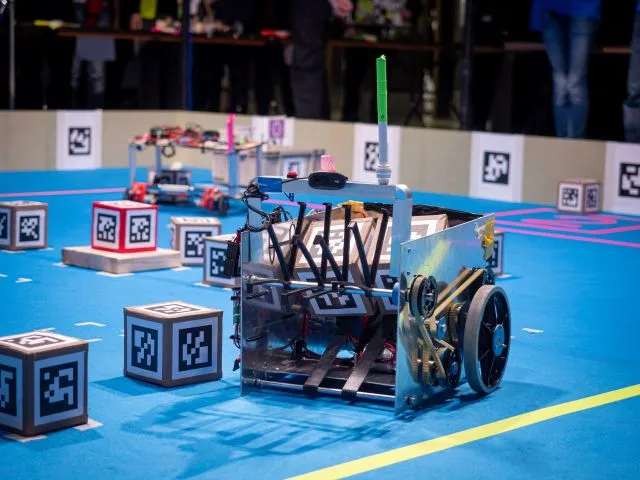
Student Robotics
Student Robotics is a competition run by the University of Southampton for sixth form students. The challenge is to build an autonomous robot in 6 months to compete in their 2 day competition, against other robots in an arena, to win a logical game.
I thoroughly enjoyed competing at Student Robotics as leader of the Hills Road robotics society. It gave me the opportunity to develop my problem solving skills under pressure in a competition environment, along with being able to work closely in a team to build an advanced robot!
I worked on all aspects of the robot with the team, including hardware & circuit design, soldering and software development.
You can read more about and watch videos of our robots at the competitions below.
Year 1: Final Frontier
Our robot in a competition round.
The Challenge & Our Strategy
Our first year robot had to collect as many cubes as possible, return them to our zone, and get extra points for placing them in a “Spaceship” (box).
We built a robot with arms at the back to attach to the spaceship, a conveyer belt to move the cubes up, and a spinning flail to draw them in. The idea was the cubes would flow straight into the spaceship as we went around the arena, then we could return to our zone at the end to score maximum points.
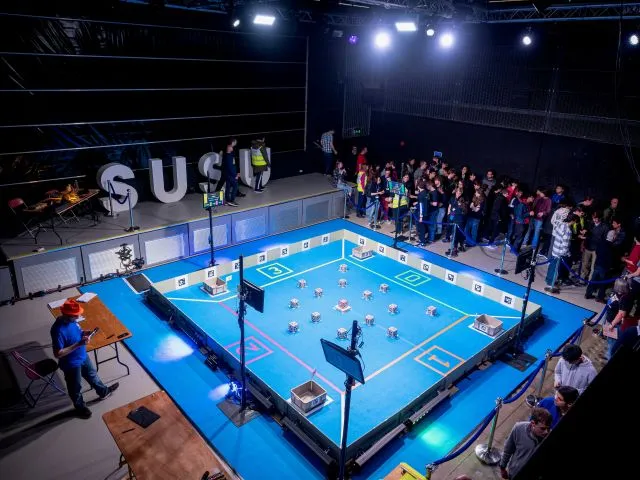
The Final Frontier arena
Problems Faced
- PID Motors: Our motors used PID (to calculate the exact distance travelled) via a Pico microcontroller running C. The motors would occasionally randomly spin in the middle of a round, this was due to noise in the connection causing incorrect readings. We fixed this by adding capacitors to absorb the noise over the digital connection.
- Docking: We had many issues with the docking not being successful every time, so we decided to tape up the back of the robot and carry the cubes instead, and re-write the logic code to change the direction of the conveyer at different points of the game to serve a similar purpose.
Our robot with cubes held inside with the new strategy.
Lessons Learned
- The importance of QA testing before production! If we had started testing the robot earlier, some of the motor issues would have been discovered earlier with the poor wiring…
- Problem Solving: We had to adapt and solve problems under down-to-the-second pressure, and sometimes completely re-think the whole problem!
- Teamwork: We stayed together as a team throughout the competition, and I was able to successfully delegate tasks and support as a leader.
Year 2: Urban Heights
This year our robot got to the quarter-finals below!
The Challenge & Our Strategy
This competition involved stacking cubes as high as possible, scoring points for having the highest tower in the corner of an arena.
We built a robot that used a sucker and scissor-lift crane mechanism to pick up cubes, then move them and drop them onto each tower.
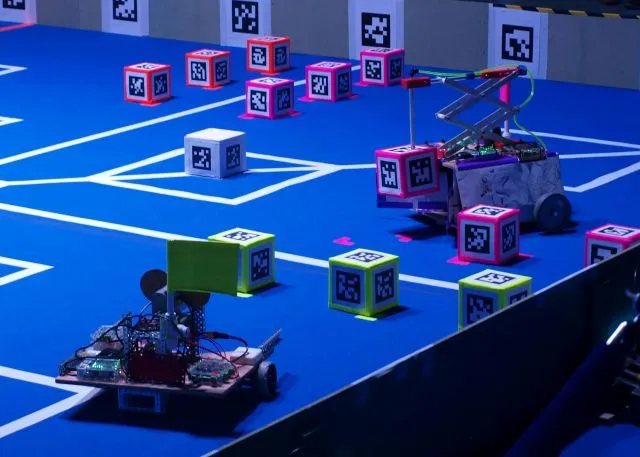
Our robot with a cube collected!
Problems Faced
The strategy was successful at the competition, and we were able to start testing slightly earlier than last year (learnt our lesson from year 1), but we still faced a few issues:
- Inaccurate sucker: The sucker would sometimes fail to properly attach to the cube. I fixed this in software by reversing after the software thought the cube had been picked up, and if the cube had not “disappeared” (as it was above the camera if picked up), a second attempt would be made.
- Poorly Calibrated Camera: The camera was right at the bottom of the robot, which caused issues with the reading of the Apriltags (QR Codes) on the cubes to work out distances. So, we had to measure and re-calibrate at the competition.
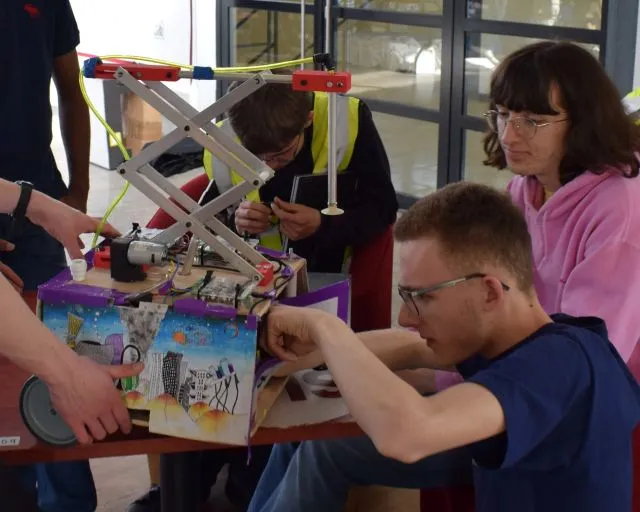
A spot of debugging…
Lessons Learned
- Suckers aren’t reliable! Next time, I would use a mechanism to grab and raise the cube, as it could be placed higher more reliably, without the delay of re-attempting pick-ups!
- I would love to work on robots in future as a career!